



We’ve have been running AIR SEO campaigns for over six months now, which is just about enough data to start drawing conclusion as to what is working. These campaigns are AI Ready SEO, Not AI first GEO, AEO, LLMO or whatever other initialism is hot right now.
You can find more information about that here, but this article explains the impact we are seeing from our AIR SEO activity and why we believe that is. The implementation we have achieved and data this has provided is such that these insights are based less on LinkedIn conjecture from AI bros and grifters, and based on performance metrics directly from Google Analytics, Google Search Console and some trusted third party tools and crucially, all tied back to revenue. The true KPI that should matter for any organic search marketing campaign.
For clarity and disambiguation, the examples we provide in this article, relate to a campaign we are running in the competitive discounts, offers and voucher code sector, in the UK. The tactics, implementation and wider strategy however, are the same across all of our AIR SEO campaigns.
In terms of how you choose to apply this to your own campaigns, if indeed you do, this will take your own intuition and for you to draw your own conclusions based on the nuances of your particular project. But broadly, we believe many of the core principles should apply.
TL:DR – What Have We Learned from 6 Months of AI SEO?
After six months of live AIR SEO implementation in the highly competitive discount code sector, the core findings are:
- AI/LLM retrieval sits on top of traditional search rather than replacing it.
- Strong technical SEO foundations, clean server side rendered HTML, sensible content structure, and consistent entity usage are what make AI retrieval work.
- A single brand prompt like “[brand] discount code” is decomposed by query fan out into multiple weighted intent clusters, and a page must satisfy all of them to be retrievable whichever subquery fires.
- AI crawlers largely do not execute JavaScript, so client side hydrated content is invisible to them.
- Related information should sit in or near the same chunk because retrieval happens at passage level.
- Token efficiency is real but should not be over optimised at the expense of the reader.
- Citations and AI share of voice are vanity metrics; the KPIs that correlate with ROI are LLM referral traffic and revenue from AI sources. This is out AIR SEO ethos – AI Ready, not AI first and with revenue as the core KPI.
So, the retrieval layer that powers AI search sits on top of the traditional search layer. It does not replace it. Strong technical SEO foundations are what make sophisticated AI retrieval possible in the first place, and a lot of classic content marketing principles still carry the weight.
You can drive LLM performance without reinventing the wheel and creating a whole new channel or product. But you do need to use the data at your disposal and think carefully about structure in order to perform in traditional search, AI search and satisfy the end user . The good news is that most of the optimal structural work is in the user’s interest anyway, which is helpful.
Table of Contents
- TL-DR
- Fan out query analysis, and why one prompt is never one query
- Then the retrieval layer decides if your content is even ingestible
- JavaScript: the rendering problem is real
- Chunking: put related things near each other
- Token efficiency is real, but do not lose your head over it
- Entities, embeddings, and cluster collision
- On the metrics, because this is where the grift lives
- What this all adds up to
- Sources and further reading
Now for the detail.
Fan Out Query Analysis & Why A Prompt Is Not a Query
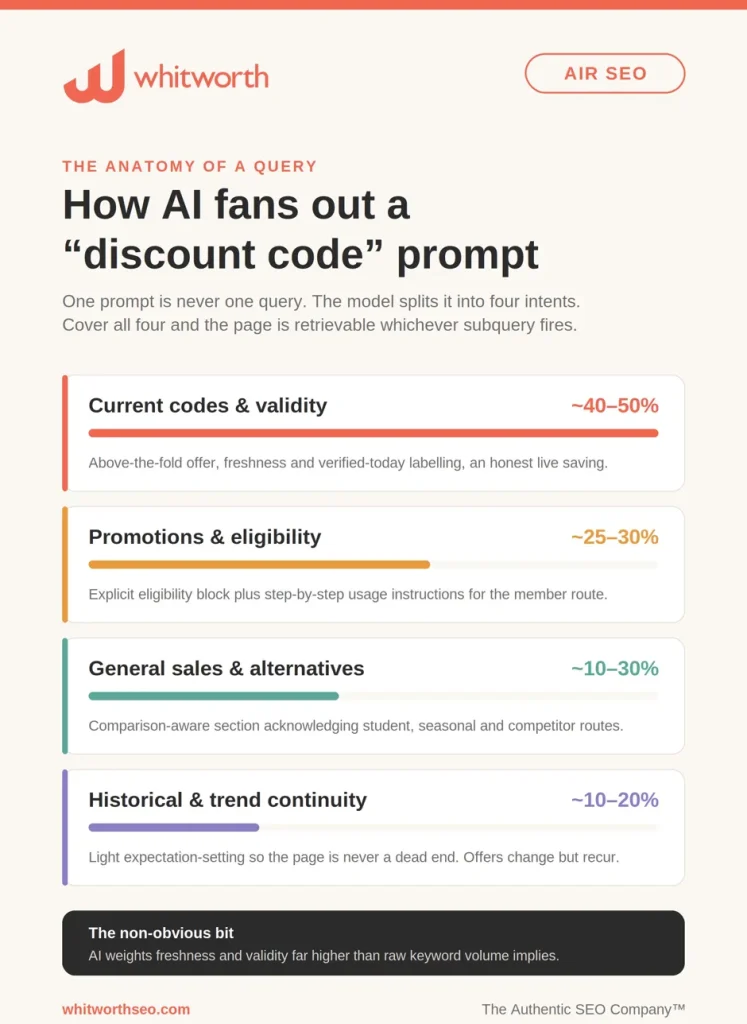
A “[brand] discount code” prompt is never answered as a single query. The model decomposes it into multiple intent clusters and runs them in parallel before synthesising one answer. This is query fan out, and it is now well documented across the industry. Google’s AI Mode breaks a prompt into a set of subqueries, retrieves content for each, and stitches the results together into a single response. One question in, a dozen retrieval queries out.
In our campaign, the dominant brand prompt decomposes into four core intent clusters, weighted roughly as below. The weighting is based on analysis across more than twenty core keyword clusters, all with significant search volume of over 20,000 per month.
| Intent cluster | Approx weight | What the user actually wants |
|---|---|---|
| Current valid codes | High | Codes that work right now |
| Specific offers | High | Named or category offers (student, NHS, seasonal) |
| Brand and trust signals | Medium | Is this site legit, are the codes real |
| Terms and eligibility | Lower | Conditions, exclusions, expiry |
Here is the part that matters for how you build the page.
The page has to satisfy all four elements to be retrievable whichever subquery fires. You are not optimising for one keyword. You are making sure your content is a credible source for every tile in the mosaic the model is assembling. That reframing, from ranking for a term to being cited across the decomposition, is the new challenge when looking to be ranked as well as surfaced and cited.
An interesting observation for the discount sector, is that AI weights freshness and code validity far higher than raw keyword volume implies. And the fan out frequently shows no distinct keyword cluster at all. The model is chasing intent and recency, not just matching strings. For example:
Taking the query “NHS discounts.” The member offer cannot sit on its own separate NHS query and expect to get picked up. It has to be surfaced inside the current codes and specific offers intents, because those are the dominant subqueries that actually fire. Park it on an isolated NHS page and it never gets retrieved against the prompts that matter. Same offer, completely different outcome, purely down to where it lives in the structure.
If you want to go deeper on the mechanics, iPullRank’s breakdown of the underlying patent work on fan out is a great read and Ekamoira’s original research quantifies the subquery counts. Search Engine Land’s guide is a solid primer on the subquery types, if you are just getting started with AI search.
The Retrieval Layer Then Decides If Your Content Is Even Ingestible
Before any of the ranking even happens, there is a basic but fundamental stage that will make or break whether or not you are even considered. Can the agent actually read your content? Fundamental SEO, but even more important for less sophisticated user agents and bots. This is where a lot of commercial sites are missing a trick, or just sticking their heads in the sand.
JavaScript Is Not Rendered by Most LLMs (Even Google)
The sentiment that AI crawlers do not execute JavaScript often, if at all, seems to be true. Our data backs it up. If a commercial page leans on client side hydration for its core content, that content is simply absent from the index the agents are chunking.
This is not a Google problem. Google has spent over a decade building a rendering service that eventually processes JavaScript. It’s not perfect and we see time after time, that this impacts traditional rankings versus websites that serve all their key content in the response HTML. AI crawlers don’t stand a chance.
Most AI crawlers, including GPTBot, ClaudeBot, and PerplexityBot, cannot execute JavaScript and only see the initial HTML. The work some teams have done analysing crawler behaviour at scale is blunt about it – across hundreds of millions of fetches, there is zero evidence of JavaScript execution, and the rhetoric from earlier in the year that this is executed has been all but put to bed. This could of course change, but many LLMs simply cannot afford to execute all the JavaScript they encounter (if Google can’t, then the LLMs likely never will). But currently, this is the state of play.
Do not assume that because Google indexes your client rendered content, the AI crawlers will too. A client side rendered React app that Google eventually indexes correctly might be completely invisible to every AI crawler on the internet.
The fix is old fashioned and unglamorous. Server side rendering and clean HTML.
Chunking – Put Related Concepts Close Together
You do not need to pre chunk everything and spoon feed the agents. They do the chunking so you don’t have to, but there are things we can do to help and by doing this, we are only improving the quality and engagement of our content anyway.
In our campaigns, if we explain an offer in one place and the eligibility three sections down, the model does not reliably connect them at retrieval time. It pulls a passage, not the whole page, so the passage has to make sense on its own. Google’s fan out works at passage level, evaluating specific sections rather than the page as a whole, which is why proximity matters.
Let your entity data, People Also Ask data, and fan out analysis inform how you structure content. Those data sources are telling you which facets get retrieved and how the model groups them. None of this is bad for the end user, and is a better use of an LLMs tokens, which you will be rewarded for. Ensure you take full advantage of your context window.
Token Efficiency Is Real
LLMs run on a tight context window budget, and they are effectively taxing filler copy. Padding and jargon push key information out of the usable window. Lead with the answer and think about content value per token.
But, and this is important, do not obsess over it and over optimise. Stripping every page back to terse, robotic bullet points to chase token efficiency will wreck the experience for the human reading it, which then becomes counter-productive. So find that sweet spot, this is where anyone with journalistic experience will likely reven in the new area of search and content marketing.
Get the balance right. Lead with answers, cut the waffle, keep it readable.
Entities, Embeddings & Cluster collision
Vector embeddings cluster by meaning, so consistent entity usage tightens your brand centroid. Use the same names for the same things, consistently, across the site. The tighter and more coherent your entity usage, the more clearly the model understands who you are and what you cover. And, you may want to complement this with a nicely structured EntityMap.
Watch for cluster collision, where your content sits so close in vector space to another entity or a competitor that the model conflates the two. In a competitive space with lots of near identical sites, this is a genuine risk and needs careful consideration.
Metrics & KPIs – Watch For The Grift
This will likely cause a stir, but much of the industry are using the wrong KPIs to benchmark their campaigns, so they can sell performance that doesn’t necessarily translate into traffic or revenue.
Citations and AI share of voice are fluffy at best, and they do not reliably correlate with LLM referral traffic. The data fuelling those scores is broad, noisy, and easy to dress up into an impressive looking dashboard that means very little commercially.
Our AIR SEO KPI is mainly LLM referral traffic and revenue from AI sources, because that is what correlates with ROI. Everything else is a vanity metric right now. If your AI search reporting leads with “share of voice” and never gets to revenue, ask why. These visibility scores are currently based on prompts that may never occur, and also bring back differing results for the same person, so currently I believe them to be flawed.
This is the same principle that has run through everything I do. Revenue and commercial outcomes over vanity metrics. AI search does not change that. It just gives people new vanity metrics to hide behind. Attribution was already pretty flawed in our sector, and it’s not even trickier – but that doesn’t mean we should fluff up our KPIs to suit our own ends.
Conclusion – Consider Retrieval As a Layer of Your SEO Strategy
AI retrieval is not a separate channel you bolt on. It is a retrieval layer built on the traditional search layer, with a lot of its own nuances.
The foundations that have always mattered, clean technical delivery, sensible structure, consistent entities, content that answers the correct intent, are the foundations that make AI retrieval work. You do not need to reinvent the wheel. You need to use the data you have, respect how the model reads and chunks your content, and keep your eye on the metrics that deliver genuine growth.
That is AIR SEO. AI Ready, not AI first. Same commercial discipline, applied to a new retrieval layer.
If you want to talk about how this applies to your sector, find me on LinkedIN, or contact me via this website.

