


I’ve just spent two days in a training room in Nottingham, taking an agency team through how AI search actually works. Within the first hour someone asked the question I get asked every week. “Our competitor’s agency is selling GEO. Why aren’t we?”
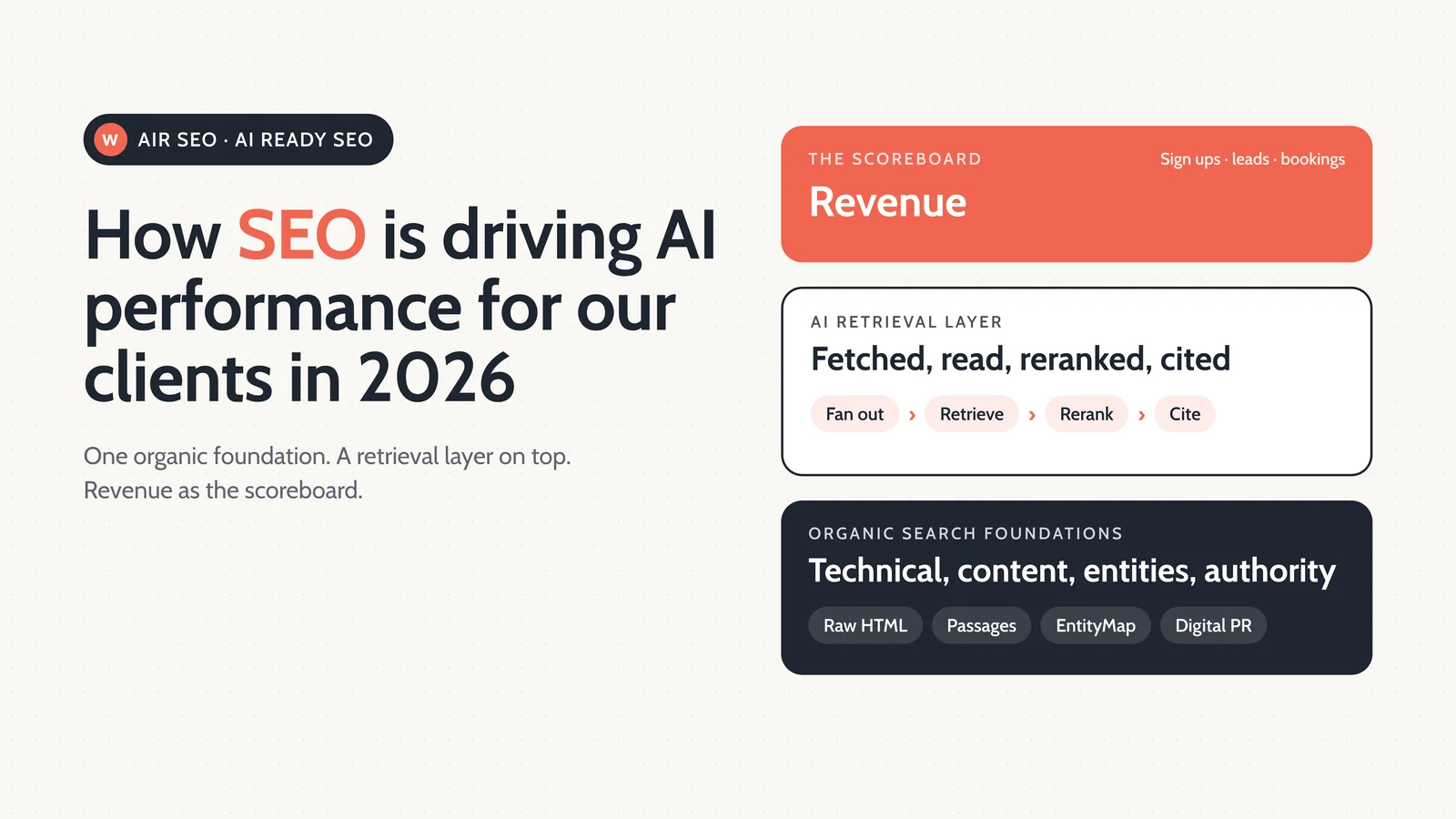
My answer hasn’t changed in a year of running AIR SEO (AI Ready SEO) campaigns. AI search optimisation isn’t a new channel. It’s a retrieval layer that sits on top of organic search, and the brands winning in ChatGPT, Gemini, and Google’s AI Overviews are, almost without exception, the ones doing SEO properly. This post is the long version of that answer, with the data from our own client campaigns to back it up.
TL;DR. What we’ve learned about SEO and AI performance in 2026
- AI search is a layer of SEO, not a separate channel. Assistants retrieve from search indexes, so rankings, crawlability, and authority still decide who gets cited. Jump to the explanation.
- Access and raw HTML come first. A Cloudflare setting can quietly block Googlebot, and the major AI crawlers don’t render JavaScript. Jump to access.
- Passages get cited, not pages. Question-led headings, answers in the first two sentences, and checkable facts. Jump to content.
- Revenue is the KPI. LLM referrals are small in volume and big in value, so measure conversions, not citation counts. Jump to measurement.
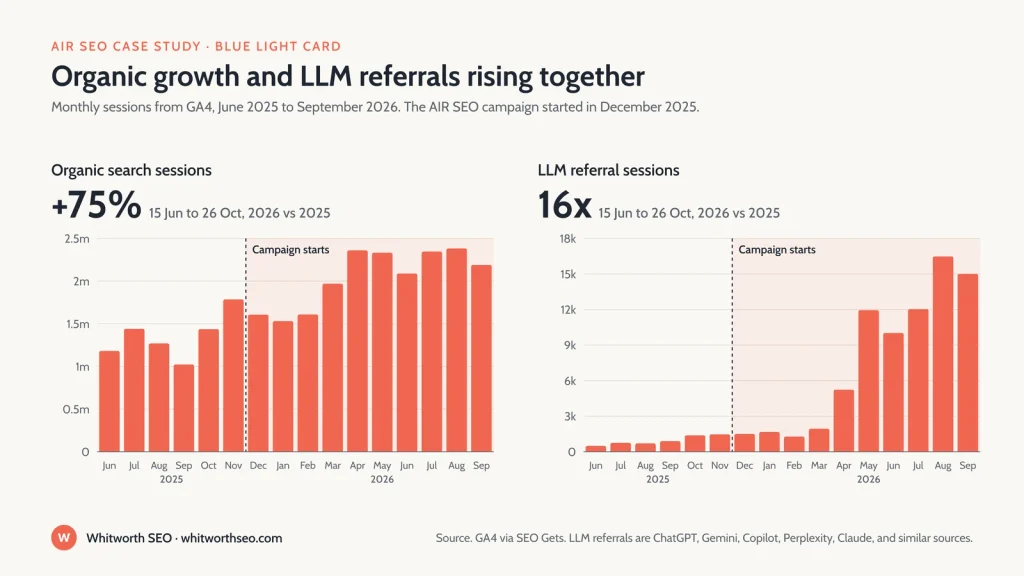
- The results back it up. Blue Light Card’s LLM referral sessions are up 16 times year on year, alongside a 75% rise in organic sessions. Jump to results.
Contents
- What is AI search optimisation, really?
- Is SEO still worth it in 2026?
- How does an AI answer actually get built?
- Can AI crawlers reach your site?
- Can AI crawlers read your content?
- How do you write content that AI search will cite?
- Why do entities matter for AI visibility?
- What shouldn’t you buy (or sell)?
- How should you measure AI search performance?
- What does this look like for our clients?
- Where should you start?
- FAQs
What is AI search optimisation (aka GEO), really?
AI search optimisation is the work of making a brand easy for AI assistants to find, read, trust, and cite. In practice that’s SEO, with more attention on how content gets retrieved at passage level and how consistently a brand is described across the web.
Google says as much in its own guide to optimising for generative AI features, which states that AI Overviews and AI Mode rely on its core ranking and quality systems. ChatGPT, Copilot, and Perplexity also ground many of their answers in live search results. If you’re not in the index, or you’re buried on page four, you’re not in the answer.
The industry has produced a lot of acronyms for this. Here’s what each one usually means, and what’s actually underneath it.
| Term | What people usually mean | What it actually is underneath |
|---|---|---|
| SEO | Ranking in Google | Being crawlable, relevant, and trusted across every search surface |
| GEO (generative engine optimisation) | Getting cited in ChatGPT and AI Overviews | SEO, plus passage structure, entities, and corroboration |
| AEO (answer engine optimisation) | Winning direct answers | Featured snippet thinking, applied to assistants |
| LLM SEO or AI SEO | Optimising for large language models | Access, raw HTML, and content that survives retrieval |
| AIR SEO | Our approach | SEO fundamentals with the retrieval layer built into every stage |
That’s why we call it AI ready, not AI first. Optimising primarily for LLMs means chasing a small share of total search demand while risking the UX and conversion rate that pays the bills. Building on solid SEO foundations captures both.
Is SEO still worth it in 2026?
Yes. SEO is the reason brands appear in AI answers at all, and it still drives the majority of organic revenue for every client we work with. What has changed is how clicks are distributed.
Ahrefs’ 2026 re-run of its AI Overviews study found that AI Overviews reduce the click-through rate for the top organic result by 58%, across 300,000 keywords. Informational content is taking the biggest hit. Commercial pages, comparison pages, and anything that requires a decision are holding up far better.
So the answer isn’t to abandon SEO. It’s to stop measuring it by traffic alone, and to point the effort at the pages that make money. I’ll come back to that in the section on the crocodile effect.
How does an AI answer actually get built?
Every major assistant runs a version of the same pipeline, usually called retrieval augmented generation (RAG). The model looks things up before it answers, and it can only cite what it can easily retrieve. A page has to survive every stage to be cited.
- Plan and route. The prompt is split into several sub-queries, and the system decides whether to use its index, the live web, or both.
- Retrieve. Candidate pages and passages are fetched. If a bot is blocked, or the content needs JavaScript, you’re not in the pool.
- Rerank and critique. Passages are scored for relevance, quality, and agreement with other sources. Clear, self-contained answers win.
- Synthesise and cite. The answer is written and sources are attributed. Then comes the question that matters. Did it make money?
Fail at retrieval and nothing downstream matters. That’s why access and raw HTML come before content in every AIR SEO audit we run.
What is query fan-out?
Query fan-out is how AI search expands one prompt into a set of related searches, then combines the results into a single answer. Search Engine Land’s guide to query fan-out is a good primer.
Take a prompt like “What’s the best SMS platform for a UK business sending appointment reminders?” The planner might run searches for SMS API pricing in the UK, appointment reminder features, GDPR and consent rules, reviews and comparisons, and delivery rates. Each search retrieves its own candidates. The brands that cover those sub-queries well are the ones that get cited.
A prompt is not a keyword. But the sub-queries look an awful lot like the People Also Ask tree, which is why we map fan-out and PAA together in every content brief.
Can AI crawlers reach your site?
Not always, and most site owners don’t know. There are three classes of AI crawler, and each one needs a different decision.
| Crawler class | What it does | Our default stance |
|---|---|---|
| Search | Builds the index an assistant answers from | Allow |
| Agent | Fetches a page live while a user waits for an answer | Allow |
| Training | Collects content to train or fine-tune models | A commercial decision, made deliberately |
The Cloudflare training trap
Cloudflare now groups bots into Search, Agent, and Training categories. From 15 September 2026, crawlers that do more than one job are judged on everything they do, and the most restrictive rule wins. Googlebot, Bingbot, and Applebot each crawl for search and training with one bot. A blanket Training block can therefore stop them reaching your site at all.
In other words, a client who “blocked AI to protect their content” in 2025 may have quietly blocked Google. I wrote about it in detail in the Cloudflare changes and how they impact SEO and AI search. Check the dashboard, then check the server logs. Logs are the only proof of what actually crawls.
Can AI crawlers read your content?
Only if it’s in the raw HTML. Google renders JavaScript, eventually. Vercel’s analysis found that none of the major AI crawlers render JavaScript, including GPTBot, ClaudeBot, and PerplexityBot. They request the files. They just don’t run them.
On a recent enterprise marketplace audit, over a quarter of URLs only showed their body copy after JavaScript had run. To an AI crawler, those pages were close to empty. Here’s how to check your own site.
- Compare “view source” with “inspect element” on your key templates.
- Crawl with Screaming Frog or Sitebulb with rendering on and off, then compare word counts.
- Make sure copy, links, prices, and FAQs are in the first HTML response.
- Use server-side rendering or static generation on commercial templates. JavaScript should enhance a page, never carry it.
This also matters for migrations. I’ve seen re-platforms to React or Next.js wipe out AI visibility overnight, which I covered in how poor migrations are destroying AI and SEO visibility.
How do you write content that AI search will cite?
Write passages that make sense on their own. Retrieval systems split pages into chunks, roughly by heading, and score each chunk against the query. They rank passages, not pages.
Those systems are hybrid by design. Classic keyword scoring (BM25) and vector similarity are run side by side, then fused into one ranking. So keyword precision still counts, but you can also be cited without matching the prompt’s exact words, as long as the meaning is clear.
What does a citable passage look like?
- The heading is the question a buyer actually asks.
- The answer lands in the first two sentences.
- It includes a specific, checkable fact, such as a price, a range, or a threshold.
- Context and evidence follow the answer, they don’t precede it.
- A named, accountable author and an updated date sit on the page.
- It still works if it’s lifted out of the page entirely.
You’ll notice that’s just good journalism. Good passage structure is also good UX. It’s scannable, direct, and easier to convert from. AI search might end up cleaning up two decades of SEO mess, the “ultimate guides” padded to hit a competitor’s word count.
Does word count matter for AI search?
No, but density does. Every chunk costs tokens for an assistant to evaluate, roughly 1,300 to 1,500 tokens per 1,000 words of English. Filler copy is now taxed. Long pages are fine when the topic needs the depth, but padding pushes the key facts further down, and smaller models have much smaller context windows than Google.
That’s why our briefs got shorter over the last three years, not longer. Less SEO jargon, more of what a writer needs. Questions as headings, facts and entities to include, links in and out, and the conversion the page is there to drive.
Should you still publish informational blogs?
Fewer, but better. AI Overviews absorb informational clicks, so plan for it rather than fight it. Keep and refresh the blogs that earn links and citations. Merge pages that compete for the same intent, so there’s one best URL per query. Then put the effort into commercial content, such as comparison, cost, and alternatives pages, plus the non-brand demand that strong brands often ignore. If you have a bloated archive, pruning it effectively helps both crawlers and readers.
Why do entities matter for AI visibility?
Because models connect facts about a brand from many sources, and disagreement costs citations. If your founding year, product names, or locations differ between your site, Companies House, Wikipedia, and review sites, the reranker has less reason to trust you.
We start every campaign with an entity map. It’s one agreed picture of who the brand is, what it offers, and how it connects to everything else. The facts then flow into one connected schema graph on the site, with sameAs links to Wikidata, Crunchbase, and the brand’s social profiles. We also publish an EntityMap file pair in HTML and JSON, based on the EntityMap open specification. It takes a developer about ten minutes to deploy.
One practical tip. The About page is one of the most crawled pages by LLMs on the sites we audit, yet it’s usually the most neglected. Build it out properly, along with author pages for anyone whose name goes on your content.
What shouldn’t you buy (or sell)?
If an agency pitches you any of these, ask them why the fundamentals aren’t being fixed first.
- llms.txt as a ranking fix. Google’s mythbusting section says directly that Google Search doesn’t use it. Fine as housekeeping, not a deliverable.
- “AI versions” of pages. Duplicate content by another name.
- Chunk files and special markup. No assistant reads a special format. Good HTML structure is the chunking.
- Citation guarantees. Answers vary by run, user, and location. Buy measured share of voice, not promises.
- GEO-only audits. A checklist that skips crawling and rendering misses the reason most sites aren’t retrieved.
- Prompt hacks and hidden text. Short-lived, risky, and against guidelines. You’ll pay for the clean-up later.
Standalone GEO is starting to look a lot like the link building upsells of a decade ago. It works when it sits on top of SEO, digital PR, and genuine review sentiment. Bolted on by itself, it’s a bill for something you should already be getting.
How should you measure AI search performance?
Lead with revenue. Attribution across analytics platforms is broken, and it isn’t getting fixed any time soon. So we report revenue holding or growing against visibility, rather than chasing every click. Here’s the hierarchy we report against.
- Revenue. Sales, leads, sign-ups, and bookings from organic, including AI referrals.
- Conversions. By landing page, template, and market.
- Qualified sessions. Non-brand organic, AI referrals, and engaged visits.
- Visibility. Rankings, share of voice, and AI Overview presence.
- Diagnostics. Citations, crawl stats, index coverage, and prompt set results.
For B2B clients that means getting into the CRM, whether that’s HubSpot or Salesforce. If an agency can’t see what happened after the form fill, it shouldn’t be promising revenue.
How do you track AI traffic in GA4?
Start with the native channel, then add your own. GA4’s default channel group now includes an AI Assistant channel that picks up sources like ChatGPT, Gemini, and Copilot. Note that clicks from Google’s AI Overviews and AI Mode still land in Organic Search. To catch everything else, create a custom channel group under Admin, then Data display, then Channel groups. Add an “AI Referrals” channel, place it above Referral so it wins, and use a source rule like this one.
(chatgpt|
Report it next to organic, not inside it. And expect some assistant clicks to arrive with no referrer at all and land in Direct.
How many prompts should you track?
Between 20 and 50 per market. Keep the set small, stable, and commercial. Use the prompts a buyer asks before they spend, fix the wording and the schedule, and weight each one by the revenue behind the topic. Change the set and you lose the baseline.
Log which domains and pages get cited, not just whether the brand appears. That list becomes your digital PR and content brief. And read the trends over weeks, never from one screenshot, because answers change by run, user, and location. AI visibility tools are useful for direction, but they’re a diagnostic, never the headline KPI.
What is the crocodile effect?
It’s the shape you see in Search Console when impressions rise and clicks fall, like an open crocodile’s jaw. AI Overviews and AI Mode answer more on the results page, and sponsored results are taking more space too. Well-optimised brands see fewer clicks but higher intent on the ones that land, and revenue falling far less than traffic, or growing.
Explain the gap to clients before they ask. Segment by brand, template, market, and surface before drawing conclusions, because aggregates hide where you’re winning and losing. And tell the client when you were wrong, in the same note. It’s the fastest way to be believed when you’re right.
What does this look like for our clients?
Across our campaigns, LLM referral traffic tracks SEO visibility closely, because the retrieval layer sits on top of rankings. Here are three examples.
Blue Light Card. Organic and LLM referrals rising together
We started our AIR SEO campaign with Blue Light Card in December 2025. We fixed the foundations first, including a Cloudflare AI crawler review with their IT team, 3,072 orphaned pages triaged and reintegrated, and structured data rebuilt across 17 templates. Then we scaled content that answered real member questions, with one intent per URL.
Comparing 15 June to 26 October 2026 with the same period of 2025, Blue Light Card has seen these results.
- Organic search sessions up 75%, from 5.57 million to 9.76 million.
- Google clicks up 48%, from 4.12 million to 6.11 million, with impressions more than doubling.
- LLM referral sessions up 16 times, from around 3,800 to over 63,000.
- Around 96% of LLM referrals come from ChatGPT so far this year.
Notice the shape. LLM referrals didn’t take off on their own. They climbed as organic visibility climbed. We treated AI visibility as part of the organic campaign, not a side project, and measured sign-ups first, with AI share of voice as the diagnostic. The campaign is a finalist at the 2026 UK Search Awards.
Fresha. Foundations at enterprise scale
Fresha is a booking marketplace running across 13 regions on one authoritative domain. With two AIR SEO audits and a six-month roadmap of around 60 prioritised tickets, we tested entity maps and technical fixes at scale. Fan-out and PAA analysis turned two hubs into a full topic map. Copy moved into the raw HTML, headings coded as paragraph tags became real H2s, and entity facts and structured data were made consistent, with an EntityMap live in HTML and JSON.
From 1 January to 26 October 2026, Fresha earned over 1.9 million more non-brand Google clicks than in the same period of 2025, a 7.8% rise on a base of more than 24 million. At that scale, single-digit growth in non-brand demand is a lot of new customers. LLM referrals rose with each release, tracking organic performance closely.
One ChatGPT session, one £130k order
For a B2B manufacturing client, ChatGPT sent just 15 sessions in a year. One of them turned into a £130,000 wholesale order. That’s the case for AI search in one sentence. The volume is small. The value isn’t. And you’d never see it if you were only counting citations.
Where should you start with AI search optimisation?
Before any client call, we answer six quick questions. They follow the retrieval pipeline, and they turn a chemistry call into a diagnosis.
- Can it be fetched? Check robots.txt, Cloudflare bot settings, status codes, and redirects on key templates.
- Can it be read? Compare raw HTML against the rendered page, or run a crawl with JavaScript switched off.
- How is it structured? Look at headings, hubs, and internal links on the money pages.
- Will it be reranked? Does each section answer one question, early and plainly?
- Will it be trusted? Check authority, entity facts, reviews, and the About page.
- What does the data say? Look at Search Console trends, AI referrals in GA4, and brand share of voice.
Then prioritise. Every finding gets a P1 to P3 priority, an owner, a date implemented, and a reason the client would care. Those last two columns are the ones most audits forget, and they’re the reason fixes actually ship.
FAQs
How do you optimise for AI search?
Make sure AI crawlers can reach your site and read your content in the raw HTML. Then structure pages so each section answers one question in its first two sentences, keep your brand facts consistent everywhere, and earn coverage on the sources assistants cite. Measure it against revenue, not citation counts.
What is AI search optimisation called?
It goes by several names, including GEO (generative engine optimisation), AEO (answer engine optimisation), LLM SEO, and AI SEO. Underneath, they all describe SEO with extra focus on passage-level retrieval and entities. We call our approach AIR SEO, or AI Ready SEO.
Is GEO different from SEO?
Not in any way that justifies a separate budget. GEO relies on the same crawling, indexing, relevance, and authority signals as SEO, because AI assistants retrieve from search indexes. The useful parts of GEO, such as passage structure and entity consistency, belong inside a good SEO campaign.
Does llms.txt help with AI visibility?
There’s no evidence it does. Google says its Search doesn’t use llms.txt, and no major assistant has committed to reading it. It does no harm as housekeeping, but it shouldn’t be sold as a ranking fix.
How do I track ChatGPT traffic in Google Analytics?
GA4’s default AI Assistant channel captures ChatGPT, Gemini, Copilot, and others. For fuller coverage, add a custom channel group with a regex source rule for AI assistants and place it above Referral. Some ChatGPT clicks arrive without a referrer and show as Direct.
Is SEO dead because of AI?
No. AI assistants depend on search indexes and rankings to decide what to cite, so SEO is what gets brands into AI answers. Our clients’ LLM referrals rise in step with their organic visibility. What’s changing is how clicks are distributed and how success should be measured.
Final thoughts. A layer, not a channel
The two days in Nottingham ended where they started. Technical SEO still comes first. Let the assistants crawl, and remember most of them won’t render your JavaScript. Map entities, fan-out queries, and passages. Show the expertise and experience AI can’t fake. Use AI tools for research, briefing, and analysis, but keep the strategy human. And lead with revenue.
That’s AIR SEO. AI ready, not AI first. If you’d like us to look at your site, or train your team on the same approach, take a look at our AIR SEO campaigns and SEO training, or get in touch.
Sources and further reading
- Google Search Central, Google’s guide to optimising for generative AI features on Google Search, updated July 2026.
- Ahrefs, AI Overviews reduce clicks, 2026 update, February 2026.
- Vercel, The rise of the AI crawler, December 2024.
- Google Analytics Help, Default channel group.
- Search Engine Land, Query fan-out in AI search.
- iPullRank, Expanding queries with fan-out.
- Cloudflare, Content Independence Day, July 2025.
- EntityMap, the EntityMap open specification.
- Whitworth SEO, What we’ve learned from 6 months of AI Ready SEO campaigns.

